What to Expect During Your First Osteopathy Appointment
Booking your first osteopathy appointment can feel equal parts hopeful and a bit unknown. Will it hurt? Do you need scans? Will you be told to “just rest”? At Ascot Vale Osteopathy, we keep things simple: we listen properly, we explain what we’re seeing, and we build a plan that makes sense for your body and your life. This guide walks you through exactly what happens in a first appointment, so you can arrive feeling confident.
First up: what osteopathy is (and what it isn’t)
Osteopathy is a hands-on healthcare approach that focuses on how your body’s structure (joints, muscles, nerves, connective tissue) affects how you function and feel. Our core belief is that your body has an incredible capacity to heal and self-regulate — and that improving movement is often a key part of improving wellbeing.
Osteopathy isn’t a one-size-fits-all “crack and go” session. It’s a full assessment, a clear explanation, and treatment that’s matched to your needs.
Before you arrive: what to bring and how to prepare
You don’t need to do anything fancy.
Wear comfortable clothing you can move in (activewear is perfect)
Bring any relevant reports or imaging if you have them (not required)
Think about your main goals: What do you want to get back to doing?
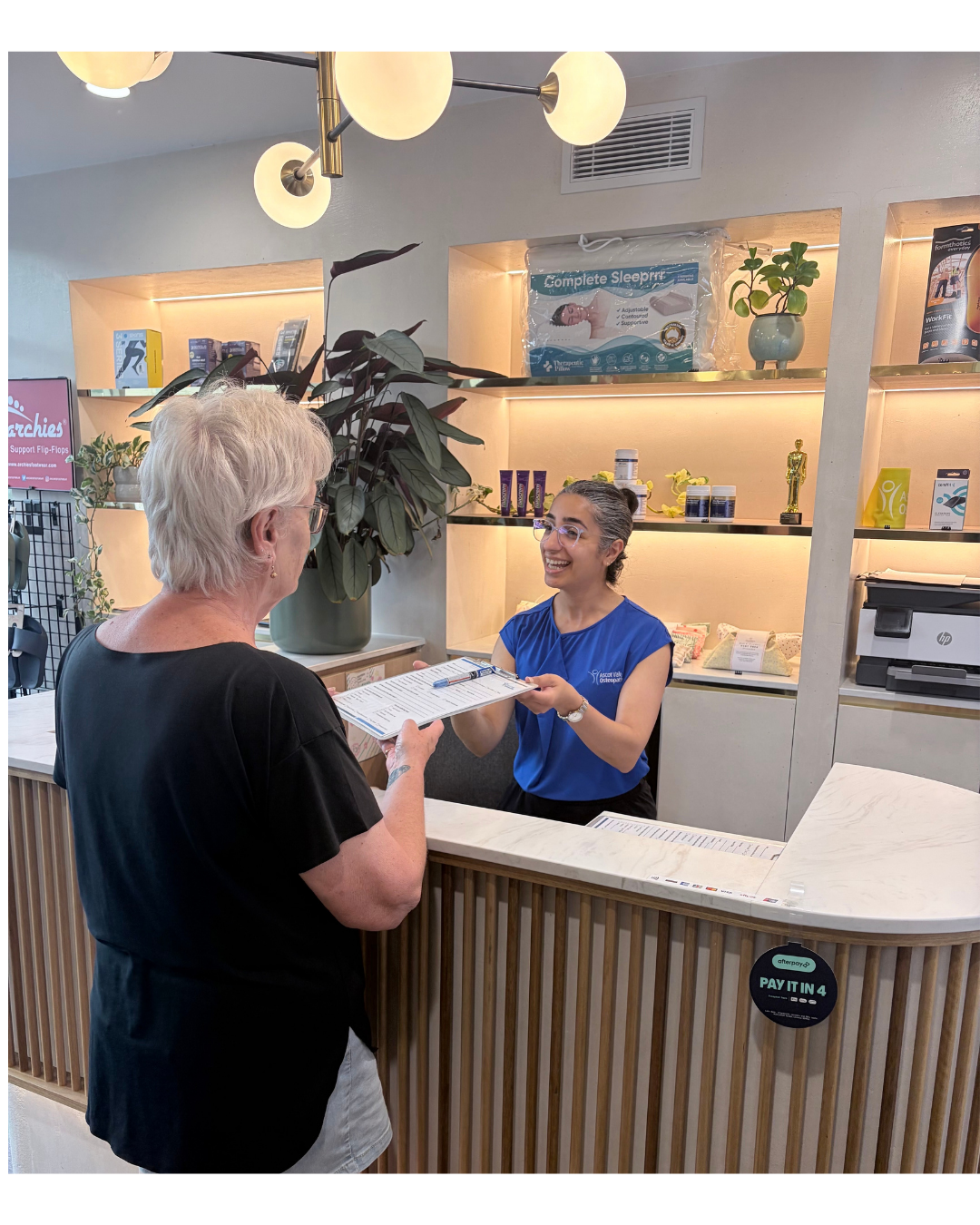
Upon arrival you’ll be asked to fill out a personal information form which
includes brief questions about medical history and a consent. Your first
appointment starts with conversation. This is where we do what many people tell
us they’ve been missing: we listen.
We’ll ask about:
Your main complaint (where it is, what it feels like, what triggers it)
When it started and what’s changed over time
Your work setup (hello, desk neck and back)
Exercise, sport, sleep, stress, and recovery
Past injuries, surgeries, and relevant medical history
What you’ve tried so far (and what helped or didn’t)
This isn’t just box-ticking. It helps us understand the root cause, not just chase
symptoms.
Step 2: Understanding your goals (the part that changes everything)
Pain is one part of the story — but it’s not the whole story.
We’ll ask what success looks like for you. That might be:
Getting through a workday without headaches
Returning to running without flare-ups
Feeling strong and stable during pregnancy
Lifting your kids without that “uh oh” twinge
Sleeping through the night again
When we’re clear on your goal, we can tailor the assessment and plan to match.
Step 3: Physical assessment (movement, strength, and the “why”)
Next, we’ll assess how your body is moving and functioning. Depending on what’s going on, this may include:
Posture and movement screening
Range of motion testing
Strength and stability checks
Joint and soft tissue assessment
Neurological and orthopedic tests when appropriate
You’ll be guided the whole time. We’ll explain what we’re testing and what it tells
us.
Step 4: Your diagnosis explained in plain English
No confusing jargon. No mystery. Once we’ve assessed you, we’ll explain:
What we think is contributing to your symptoms
Why it’s happening (and why it’s persisting)
What’s likely to help
What to avoid (and what you don’t need to fear)
We’re big on education because it reduces anxiety and helps you make better decisions day-to-day.
Step 5: Hands-on treatment (tailored to you)
Then we treat. Osteopathic treatment can include a mix of techniques, such as:
Soft tissue work (massage and deep pressure where appropriate)
Stretching and muscle energy techniques
Joint mobilisation
Other hands-on approaches matched to your comfort level
If you’re nervous about certain techniques, tell us. We’ll always work within your preferences and explain options. A note on discomfort: some techniques can feel “strong” (especially if tissues are
sensitive), but treatment should never feel unsafe. We’ll check in with you throughout.
Step 6: Your plan (what happens after today)
This is where we shift from “treatment” to “progress.” You’ll leave with a clear plan that may include:
What to expect over the next 24–48 hours
How many sessions might be helpful (and why)
Simple home strategies to reduce flare-ups
A rehab or movement plan to build capacity
We often prescribe tailored exercises using Physitrack, so you have clear videos and guidance — not a scribbled stick figure on a scrap of paper.
Step 7: Lifestyle and recovery support (the real-world stuff)
Bodies don’t live in clinics — they live in real life. Where it’s relevant, we’ll talk through factors that can influence pain and recovery, including:
Workstation setup and movement breaks
Training load and return-to-sport progressions
Sleep and recovery habits
Stress and how it affects pain sensitivity
Nutrition basics that support tissue health
This isn’t about perfection. It’s about practical changes that stack up.
Common questions we hear (and honest answers)
Do I need a referral?
The short answer is no you don’t. Osteopaths are primary health care professionals so an official referral from your GP isn’t necessary. However, we frequently receive referrals from GPs and when we do, wo work with your doctor to provide a treatment plan specific to your needs. If you suffer from chronic condition that is managed by your GP or other specialist doctors, your GP may refer you to us under the Chronic Disease Management Plan (CDMP), where Medicare will cover part of the consultation fee for up to 5 sessions.
“Will I need scans?”
Not always. If imaging is relevant, we’ll tell you why and what we’re looking for.
“How long is the appointment?”
All the initial consultations are 45 minutes. That includes history, assessment, treatment, and a treatment plan.
“Will I be sore after?”
Everyone responds differently to manual therapy. Some people feel a little tender or tired for a day or two — especially if you’ve been dealing with pain for a while. Many people also feel lighter, looser, and more confident moving.
“How many sessions will I need?”
It depends on your condition, how long it’s been there, and your goals. We’ll be upfront about what we recommend and adjust based on your progress.
What makes Ascot Vale Osteopathy different
We’re an inner-north Melbourne clinic that’s been supporting the Moonee Valley community since 2008. Our team is AHPRA-registered and committed to ongoing professional development. We also work with a wide range of patients — from desk-based workers and weekend warriors to pregnancy and postnatal care, chronic pain, and sports injuries. Most importantly: we care about quality over quick fixes. We’ll take the time to understand your story, treat you like a whole person, and help you build the confidence (and capacity) to get back to what you love.
Ready to book your first appointment?
If you’re in Ascot Vale or surrounding suburbs like Moonee Ponds, Essendon, Flemington, Kensington, Footscray, Brunswick, Maribyrnong, or North Melbourne, we’d love to help.
Call 03 9370 4033 or book online here.
Your first appointment isn’t about being “fixed.” It’s about being understood — and getting a clear, practical plan forward
Breathing is one of the most basic and fundamental functions of the human body, yet many of us don’t do it well. We often ignore our breathing until it becomes uncomfortable or abnormal. What we don’t always realise is how important our breath is for ...
Your core is a group of muscles that sit in your torso. They stabilise and control the pelvis and spine. When most people think of their core, they picture a chiselled six?pack. In reality, the core goes much ...
read more
In recent years, cardiovascular diseases have become a leading cause of morbidity and mortality worldwide. Among the numerous factors contributing to these conditions, LDL cholesterol has gained significant attention. LDL, or ...
You’ve finished your treatment plan. Your back pain is gone. You’re moving well, sleeping better, and getting back to the things you love.
So… do you still need to see your osteopath?
It’s one of the most common questions we hear. And it’s...
Psoas is a strong and powerful muscle, yet often overlooked, and tt can be responsible for a host of ailments.
The Psoas muscle originates from the T12 and Lumbar spinal segments, where it blends in with fibers of the diaphragm (your primary breathing ...
Websites store cookies to enhance functionality and personalise your experience. You can manage your preferences, but blocking some cookies may impact site performance and services.
Essential cookies enable basic functions and are necessary for the proper function of the website.
Name
Description
Duration
Cookie Preferences
This cookie is used to store the user's cookie consent preferences.
30 days
These cookies are needed for adding comments on this website.
Name
Description
Duration
comment_author
Used to track the user across multiple sessions.
Session
comment_author_email
Used to track the user across multiple sessions.
Session
comment_author_url
Used to track the user across multiple sessions.
Session
Google reCAPTCHA helps protect websites from spam and abuse by verifying user interactions through challenges.
Name
Description
Duration
_GRECAPTCHA
Google reCAPTCHA sets a necessary cookie (_GRECAPTCHA) when executed for the purpose of providing its risk analysis.
179 days
Google Tag Manager simplifies the management of marketing tags on your website without code changes.
Name
Description
Duration
cookiePreferences
Registers cookie preferences of a user
2 years
td
Registers statistical data on users' behaviour on the website. Used for internal analytics by the website operator.
session
Statistics cookies collect information anonymously. This information helps us understand how visitors use our website.
Google Analytics is a powerful tool that tracks and analyzes website traffic for informed marketing decisions.
ID used to identify users for 24 hours after last activity
24 hours
_gat
Used to monitor number of Google Analytics server requests when using Google Tag Manager
1 minute
_gac_
Contains information related to marketing campaigns of the user. These are shared with Google AdWords / Google Ads when the Google Ads and Google Analytics accounts are linked together.
90 days
__utma
ID used to identify users and sessions
2 years after last activity
__utmt
Used to monitor number of Google Analytics server requests
10 minutes
__utmb
Used to distinguish new sessions and visits. This cookie is set when the GA.js javascript library is loaded and there is no existing __utmb cookie. The cookie is updated every time data is sent to the Google Analytics server.
30 minutes after last activity
__utmc
Used only with old Urchin versions of Google Analytics and not with GA.js. Was used to distinguish between new sessions and visits at the end of a session.
End of session (browser)
__utmz
Contains information about the traffic source or campaign that directed user to the website. The cookie is set when the GA.js javascript is loaded and updated when data is sent to the Google Anaytics server
6 months after last activity
__utmv
Contains custom information set by the web developer via the _setCustomVar method in Google Analytics. This cookie is updated every time new data is sent to the Google Analytics server.
2 years after last activity
__utmx
Used to determine whether a user is included in an A / B or Multivariate test.
18 months
_ga
ID used to identify users
2 years
_gali
Used by Google Analytics to determine which links on a page are being clicked
30 seconds
Marketing cookies are used to follow visitors to websites. The intention is to show ads that are relevant and engaging to the individual user.
Google Maps is a web mapping service providing satellite imagery, real-time navigation, and location-based information.
Share this news article online