Lumbar Support: Epowering Your Lower Back for Everyday Life
Modern life asks a lot of our bodies — and your lower back (lumbar spine) often carries the load.
Whether you’re working at a laptop, driving across Melbourne, lifting kids, training for a fun run, or juggling everyday life, your lumbar spine is constantly helping you bend, lift, twist, and move.
It’s a real team player. And with that responsibility, it’s normal for your lower back to feel tired, stiff, or achy sometimes.
The good news? There are simple, practical ways to give your back the support and strength it needs — including lumbar support cushions, smarter desk setup, and targeted movement.
At Ascot Vale Osteopathy, we help people across Ascot Vale, Moonee Ponds, Essendon and surrounding suburbs feel confident in their bodies again — without relying on quick fixes.
What Is the Lumbar Spine?
Your lumbar spine is the strong, flexible section of your lower back made up of five vertebrae (L1–L5). It’s designed to:
Support your posture and trunk
Absorb shock as you walk, run, and lift
Allow movement through your hips and spine
Help transfer force between your upper and lower body
When your lumbar spine is irritated or overloaded, you might notice discomfort with sitting, bending, lifting, or even sleeping.
Why Lumbar Support Matters
Lumbar support isn’t just about “sitting up straight.” Done well, it can help you:
Maintain a more natural spinal position during sitting
Reduce sustained strain from slouching or long drives
Feel more comfortable during work and daily tasks
Stay active with more confidence
For many people, lumbar support is most helpful during activities where the body tends to “collapse” into poor posture — like desk work, long commutes, or relaxing on the couch.
Types of Lumbar Support (What Actually Works?)
There’s no one-size-fits-all. The best lumbar support is the one you’ll actually use — and that suits your body and lifestyle.
1) Lumbar Support Cushions
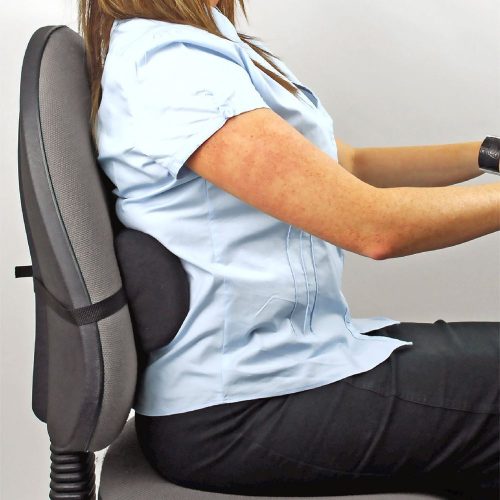
A lumbar cushion(or rolled towel) can help maintain the natural curve of your lower back when sitting.
Common uses:
Office chair support
Car seat support for commuting
Couch support during downtime
Tip: You want a gentle “fill” in the curve — not a hard push that forces you into an uncomfortable position.
2) Ergonomic Chairs and Workstation Setup
If you sit for work, a chair with built-in lumbar support can help — but it’s only one piece of the puzzle.
Helpful workstation basics:
Feet supported (floor or footrest)
Screen at eye level
Breaks every 30–60 minutes (even 60 seconds helps)
3) Movement and Exercise (The Long-Term Game)
The best “support” for your lumbar spine is often strength, mobility, and variety.
Your back generally loves:
Regular movement breaks
Hip mobility
Glute and trunk strength
Gradual exposure to lifting and daily loads
If you’re not sure what exercises are right for you, we can tailor a plan based on your body, goals, and symptoms.
Everyday Benefits of Lumbar Support
Encourages a more natural posture
Lumbar support can act like a reminder — helping reduce slumping and sustained strain.
Eases that “end-of-day” ache
Many people notice less fatigue and stiffness after long sitting periods when the lower back is better supported.
Helps you move with more confidence
When your back feels supported and you feel safe to move, it’s easier to stay active — which is key for long-term recovery and resilience.
How to Choose the Right Lumbar Support
When choosing a lumbar support cushion or setup, consider:
Comfort: Support should feel helpful, not restrictive.
Size and shape: Match it to your body and where you’ll use it (desk vs car).
Purpose: Everyday comfort? Post-injury support? Long drives?
Ease of use: If it’s annoying to adjust, you won’t stick with it.
If you’re unsure, an osteopath can assess whether lumbar support is the right tool — and how to use it without over-relying on it.
Our Approach at Ascot Vale Osteopathy: More Than a Quick Fix
Lumbar support can be a great short-term helper — but it’s rarely the whole answer.
At Ascot Vale Osteopathy, we look at the bigger picture:
What’s driving your symptoms?
What loads are you dealing with (work, sport, parenting, stress, sleep)?
What movement patterns and habits are contributing?
What do you need to feel confident again?
We combine hands-on treatment with education and practical strategies — including strengthening, mobility, and simple tools like lumbar support when appropriate.
When to See an Osteopath for Lower Back Pain
If your lower back pain is persistent, recurring, or stopping you from doing normal life, it’s worth getting assessed — especially if you have:
Pain lasting more than 2–3 weeks
Pain that keeps returning
Pain with lifting, sitting, or driving
Stiffness that limits movement
Uncertainty about what exercises are safe
Ready to Support Your Back?
If you’re not sure where to start, book an appointment with one of our osteopaths at Ascot Vale Osteopathy. We’ll assess your needs, offer personalised advice, and help you find the best approach for your body and lifestyle.
Let’s get your back feeling strong, supported, and ready for everyday life.
Your core is a group of muscles that sit in your torso. They stabilise and control the pelvis and spine. When most people think of their core, they picture a chiselled six?pack. In reality, the core goes much ...
read more
In recent years, cardiovascular diseases have become a leading cause of morbidity and mortality worldwide. Among the numerous factors contributing to these conditions, LDL cholesterol has gained significant attention. LDL, or ...
Websites store cookies to enhance functionality and personalise your experience. You can manage your preferences, but blocking some cookies may impact site performance and services.
Essential cookies enable basic functions and are necessary for the proper function of the website.
Name
Description
Duration
Cookie Preferences
This cookie is used to store the user's cookie consent preferences.
30 days
These cookies are needed for adding comments on this website.
Name
Description
Duration
comment_author
Used to track the user across multiple sessions.
Session
comment_author_email
Used to track the user across multiple sessions.
Session
comment_author_url
Used to track the user across multiple sessions.
Session
Google reCAPTCHA helps protect websites from spam and abuse by verifying user interactions through challenges.
Name
Description
Duration
_GRECAPTCHA
Google reCAPTCHA sets a necessary cookie (_GRECAPTCHA) when executed for the purpose of providing its risk analysis.
179 days
Google Tag Manager simplifies the management of marketing tags on your website without code changes.
Name
Description
Duration
cookiePreferences
Registers cookie preferences of a user
2 years
td
Registers statistical data on users' behaviour on the website. Used for internal analytics by the website operator.
session
Statistics cookies collect information anonymously. This information helps us understand how visitors use our website.
Google Analytics is a powerful tool that tracks and analyzes website traffic for informed marketing decisions.
ID used to identify users for 24 hours after last activity
24 hours
_gat
Used to monitor number of Google Analytics server requests when using Google Tag Manager
1 minute
_gac_
Contains information related to marketing campaigns of the user. These are shared with Google AdWords / Google Ads when the Google Ads and Google Analytics accounts are linked together.
90 days
__utma
ID used to identify users and sessions
2 years after last activity
__utmt
Used to monitor number of Google Analytics server requests
10 minutes
__utmb
Used to distinguish new sessions and visits. This cookie is set when the GA.js javascript library is loaded and there is no existing __utmb cookie. The cookie is updated every time data is sent to the Google Analytics server.
30 minutes after last activity
__utmc
Used only with old Urchin versions of Google Analytics and not with GA.js. Was used to distinguish between new sessions and visits at the end of a session.
End of session (browser)
__utmz
Contains information about the traffic source or campaign that directed user to the website. The cookie is set when the GA.js javascript is loaded and updated when data is sent to the Google Anaytics server
6 months after last activity
__utmv
Contains custom information set by the web developer via the _setCustomVar method in Google Analytics. This cookie is updated every time new data is sent to the Google Analytics server.
2 years after last activity
__utmx
Used to determine whether a user is included in an A / B or Multivariate test.
18 months
_ga
ID used to identify users
2 years
_gali
Used by Google Analytics to determine which links on a page are being clicked
30 seconds
Marketing cookies are used to follow visitors to websites. The intention is to show ads that are relevant and engaging to the individual user.
Google Maps is a web mapping service providing satellite imagery, real-time navigation, and location-based information.
Share this news article online