Injury prevention is every athlete’s dream. Imagine being able to do what you love—exercise, sport, outdoor activities—without getting injured. While that sounds ideal, the reality is a bit more complex.
Can we really prevent injury?
When people think about injury prevention, they often think of:
Stretching (static or dynamic)
Mobility work
Strapping and taping
Ice baths
Saunas
Manual therapy/treatment
Resistance training
Load management and rest
However, the honest answer to “Can we prevent injury?” is: probably not. Injuries are a normal part of life and activity. The word “prevention” is a bit misleading. A better term is injury risk reduction—we can’t remove all risk, but we can lower it.
What actually helps reduce injury risk?
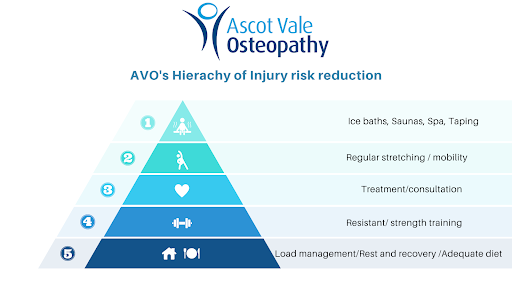
The answer isn’t black and white, but we can think about it as a hierarchy. Some factors matter more than others, and they should be prioritised.
Load management, rest and nutrition
These are the foundations of injury risk reduction, yet they are often ignored. Many people jump straight to ice baths, stretching or massage and assume that’s enough. It isn’t.
Research shows that appropriate load management, rest and recovery are consistently linked with lower injury risk. Load management means:
Training at an appropriate intensity and volume
Progressing gradually
Scheduling rest so your body can adapt and get stronger
Over?training or constantly pushing to failure can backfire, leading to poor adaptation and a higher risk of injury.
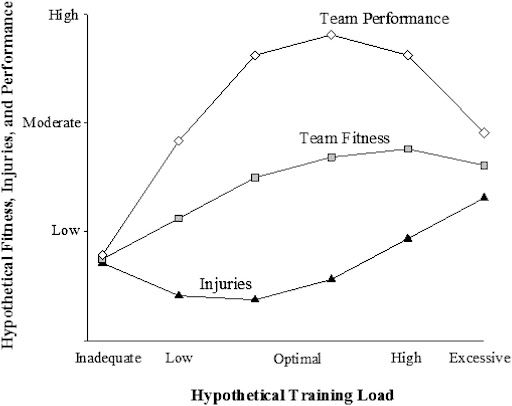
Image taken from: Gabbett TJ The training—injury prevention paradox: should athletes be training smarter and harder?British Journal of Sports Medicine 2016;50:273-280.
The above graph is a hypothesized training program in respect to training load and the factors that coaches and trainers are trying to affect. As seen in the graph, finding the optimal relationship with training and rest can not only reduce the risk of injury but increase overall performance.
Nutrition also plays a key role. Protein is important, but so are:
Omega?3 fatty acids
Antioxidants
Collagen
Calcium
Vitamins C and D
These are especially important if you train regularly, whether you’re a weekend warrior or a professional.
How can Ascot Vale Osteopathy help?
Hands?on treatment can help relieve sore, tight muscles, but that’s only part of the picture. We can also:
Help you modify your training and workload
Prescribe resistance and rehab exercises
Educate you about recovery, load and movement patterns
By building an injury risk reduction plan into your training, you become more aware of your body and how it responds. This awareness alone can significantly lower your injury risk.
Resistance training
Whatever your sport—soccer, football, combat sports, running, athletics—some form of resistance training should be in your program. Increasing strength and muscle capacity helps your body tolerate load better, which can reduce the risk of injury.
Stretching, ice baths and other extras
Stretching before and after exercise is very common, and many people use it as their main injury prevention strategy. But research suggests that people who stretch regularly don’t have significantly different injury rates compared to those who don’t.
This doesn’t mean stretching is useless—it can help with flexibility and how you feel—but it does mean more time and thought should go into load management, strength and recovery, as these have a much bigger impact on injury risk.
Even with the best plan, injuries can still happen. Sometimes there’s no clear reason—life and sport are unpredictable. When they do, we’re here to help you recover, rebuild confidence and get back to doing what you love as safely and quickly as possible.
Turnagöl, H. H., Ko?ar, ?. N., Güzel, Y., Aktitiz, S., & Atakan, M. M. (2021). Nutritional Considerations for Injury Prevention and Recovery in Combat Sports. Nutrients, 14(1), 53. https://doi.org/10.3390/nu14010053
Soomro N, Sanders R, Hackett D, et al. The Efficacy of Injury Prevention Programs in Adolescent Team Sports: A Meta-analysis. The American Journal of Sports Medicine. 2016;44(9):2415-2424. doi:10.1177/0363546515618372
Dijksma, I., Arslan, I.G., van Etten-Jamaludin, F.S., Elbers, R.G., Lucas, C. and Stuiver, M.M. (2020), Exercise Programs to Reduce the Risk of Musculoskeletal Injuries in Military Personnel: A Systematic Review and Meta-Analysis. Journal of Injury, Function and Rehabilitation, 12: 1028-1037. https://doi.org/10.1002/pmrj.12360
Jiang Z, Hao Y, Jin N, Li Y. A Systematic Review of the Relationship between Workload and Injury Risk of Professional Male Soccer Players. International Journal of Environmental Research and Public Health. 2022; 19(20):13237. https://doi.org/10.3390/ijerph192013237
Gabbett TJ The training—injury prevention paradox: should athletes be training smarter and harder?British Journal of Sports Medicine 2016;50:273-280.
Nuzzo J. L. (2020). The Case for Retiring Flexibility as a Major Component of Physical Fitness. Sports medicine (Auckland, N.Z.), 50(5), 853–870. https://doi.org/10.1007/s40279-019-01248-w
Psoas is a strong and powerful muscle, yet often overlooked, and tt can be responsible for a host of ailments.
The Psoas muscle originates from the T12 and Lumbar spinal segments, where it blends in with fibers of the diaphragm (your primary breathing ...
Websites store cookies to enhance functionality and personalise your experience. You can manage your preferences, but blocking some cookies may impact site performance and services.
Essential cookies enable basic functions and are necessary for the proper function of the website.
Name
Description
Duration
Cookie Preferences
This cookie is used to store the user's cookie consent preferences.
30 days
These cookies are needed for adding comments on this website.
Name
Description
Duration
comment_author
Used to track the user across multiple sessions.
Session
comment_author_email
Used to track the user across multiple sessions.
Session
comment_author_url
Used to track the user across multiple sessions.
Session
Google reCAPTCHA helps protect websites from spam and abuse by verifying user interactions through challenges.
Name
Description
Duration
_GRECAPTCHA
Google reCAPTCHA sets a necessary cookie (_GRECAPTCHA) when executed for the purpose of providing its risk analysis.
179 days
Google Tag Manager simplifies the management of marketing tags on your website without code changes.
Name
Description
Duration
cookiePreferences
Registers cookie preferences of a user
2 years
td
Registers statistical data on users' behaviour on the website. Used for internal analytics by the website operator.
session
Statistics cookies collect information anonymously. This information helps us understand how visitors use our website.
Google Analytics is a powerful tool that tracks and analyzes website traffic for informed marketing decisions.
ID used to identify users for 24 hours after last activity
24 hours
_gat
Used to monitor number of Google Analytics server requests when using Google Tag Manager
1 minute
_gac_
Contains information related to marketing campaigns of the user. These are shared with Google AdWords / Google Ads when the Google Ads and Google Analytics accounts are linked together.
90 days
__utma
ID used to identify users and sessions
2 years after last activity
__utmt
Used to monitor number of Google Analytics server requests
10 minutes
__utmb
Used to distinguish new sessions and visits. This cookie is set when the GA.js javascript library is loaded and there is no existing __utmb cookie. The cookie is updated every time data is sent to the Google Analytics server.
30 minutes after last activity
__utmc
Used only with old Urchin versions of Google Analytics and not with GA.js. Was used to distinguish between new sessions and visits at the end of a session.
End of session (browser)
__utmz
Contains information about the traffic source or campaign that directed user to the website. The cookie is set when the GA.js javascript is loaded and updated when data is sent to the Google Anaytics server
6 months after last activity
__utmv
Contains custom information set by the web developer via the _setCustomVar method in Google Analytics. This cookie is updated every time new data is sent to the Google Analytics server.
2 years after last activity
__utmx
Used to determine whether a user is included in an A / B or Multivariate test.
18 months
_ga
ID used to identify users
2 years
_gali
Used by Google Analytics to determine which links on a page are being clicked
30 seconds
Marketing cookies are used to follow visitors to websites. The intention is to show ads that are relevant and engaging to the individual user.
Google Maps is a web mapping service providing satellite imagery, real-time navigation, and location-based information.
Share this news article online